
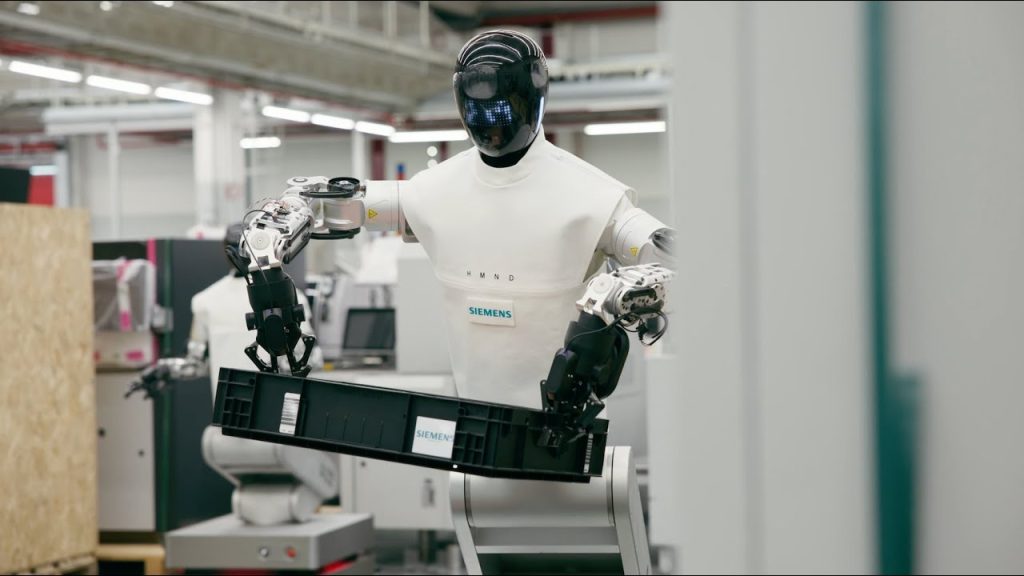
Siemens, UK robotics startup Humanoid, and Nvidia announced at Hannover Messe 2026 the results of a two-week live factory deployment conducted in January, which exceeded all predefined benchmarks.
Humanoid’s HMND 01 Alpha wheeled robot operated continuously for over eight hours at Siemens’ electronics factory in Erlangen, Germany, performing tote destacking at 60 container moves per hour, with a pick-and-place success rate above 90 per cent.
The robot operated alongside human workers and existing automated systems in a live production environment, where performance directly impacted operations.
What the robot actually did
The robot’s task involved picking storage totes, transporting them across the facility, and placing them on conveyor belts at designated handover points for human workers.
This cycle repeated until each stack was cleared. The task is repetitive and physically demanding, representing a challenge for industrial automation in unpredictable environments or where real-time human coordination is needed.
Siemens’ Global Head of Manufacturing Motion Control, Stephan Schlauss, described the Erlangen plant as “customer zero,” noting that Siemens prioritized its own factory before offering the capability to external customers.
This approach positions Siemens as the first paying customer and validator of the technology, rather than a passive evaluator.
The technology stack behind it
The HMND 01 Alpha is built on Nvidia’s physical AI stack, with on-board computing powered by Nvidia Jetson Thor.
Training was conducted using Nvidia Isaac Lab for reinforcement learning and policy development, with Nvidia Isaac Sim handling simulation-first validation before any physical deployment.
Integration into Siemens’ production systems was handled through the Siemens Xcelerator platform, which provided digital twin capability, AI-enabled perception, PLC-robot interfaces, fleet management, and industrial communication networks.
This enabled the robot to coordinate in real time with production systems, other autonomous guided vehicles, and human workers, demonstrating the level of enterprise integration that distinguishes a true factory deployment from a demonstration.
Deepu Talla, Nvidia’s vice president of robotics and edge AI, stated that the deployment paves the way for humanoid robots to achieve real production targets on active factory floors.
Seven months instead of two years
One of the more striking claims in the announcement is the development timeline.
The simulation-first approach, which involves training and validating behaviors in a virtual environment before physical deployment, allowed Humanoid to reduce prototype development from the typical 18 to 24 months to approximately 7 months.
That speed is itself a product pitch: faster iteration cycles mean faster deployment readiness for potential customers.
Founded in 2024 by Artem Sokolov, Humanoid is headquartered in London with offices in Boston and Vancouver, and employs over 200 engineers from companies such as Apple, Tesla, Google, and Boston Dynamics.
The company also produces a bipedal version of the HMND 01 Alpha, featuring 29 degrees of freedom and a comprehensive sensor suite, including RGB cameras, depth sensors, and 6D force/torque sensors.
A reference architecture, not a one-off
Siemens and Humanoid did not provide a commercial rollout timeline, but presented the Erlangen deployment as establishing a “factory-grade model” that other manufacturers can replicate, serving as a reference architecture for humanoid deployment rather than a standalone demonstration.
This positioning reflects a broader industrial trend, as humanoid robots capable of operating in human-centered environments are increasingly viewed as solutions to labor shortages in manufacturing, where fully automated lines are impractical due to product variability, safety requirements, or the need for human-robot collaboration.

CTO Robotics
CTO Robotics is a global media and consulting company dedicated to robotics, automation, artificial intelligence, and emerging technologies. We create high-impact content that reaches engineers, decision-makers, and innovators worldwide. Through articles, videos, social media campaigns, and community-driven storytelling, we help companies showcase their technologies, strengthen their brand, and connect with the right audience. Much like Interesting Engineering or Wevolver, our mission is to bridge the gap between technology providers and industry professionals — turning innovation into visibility, and visibility into growth. 👉 Whether you are launching a new product, building your brand, or looking for global recognition, CTO Robotics is your media partner for exposure, credibility, and business opportunities.
All stories by: CTO Robotics







0 Comments