
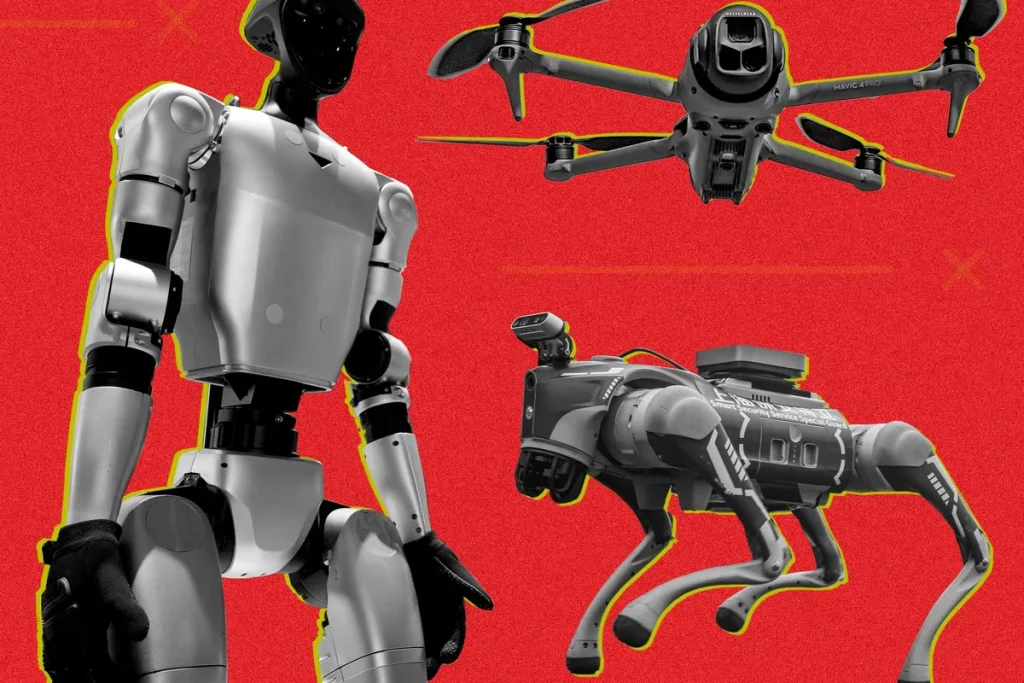
The American Security Robotics Act, a bipartisan bill introduced in March by Senators Tom Cotton (R-Ark.) and Chuck Schumer (D-N.Y.) and Representative Elise Stefanik (R-N.Y.), proposes to limit U.S. government use of Chinese ground robots including humanoids, dogs, and crawlers. The proposal came just a few days after the Federal Communications Commission (FCC) tightened its rules for new foreign-made routers. The two changes are part of a much broader decoupling of sensitive U.S. tech from China, which include semiconductors, port cranes, logistics data, telecom cellular base stations and network hardware, security cameras, passenger vehicles, and, in December 2025, uncrewed aircraft systems (UAS) including those sold by DJI.
“I see the robots and the routers as being the latest in a long line of growing tech security concerns in the U.S. vis–à–vis Chinese technology,” says sociologist Kyle Chan of the Brookings Institute in Washington, D.C, who testified on 16 April 2026 before the Congressional Select Committee on the Strategic Competition Between the United States and the Chinese Communist Party.
Certain U.S. firms, such as Ghost Robotics, may benefit, because they are among the few companies that can handle demand for ground robots from U.S. government buyers. Ground robots are finished products at the top of the chain of added value, unlike semiconductors, which are “lower” down the value chain since they are always components of other products. If the proposed ground robot ban were to move lower down the value chain, preventing American robot makers from buying Chinese-made components, those companies might have a harder time fulfilling U.S. demand. The U.S. robotics industry is in a pickle: Companies would benefit from eliminating Chinese competitors at their level of the value chain, so long as they can retain their Chinese suppliers.
The U.S. does not have a serious, overarching strategy to guiding its approach to the U.S.-China techno-economic competition.” —Stephen Ezell, Information Technology & Innovation Foundation
It’s still early for the ground robotics industry in the U.S. Adoption is not yet that high, nor are the supply chains mature yet. South Korea and Japan make many crucial robot components, for example, so if they or other countries the U.S. considers friendly can replace Chinese components the U.S. government declares unsafe, the U.S. robotics industry may be able to adapt and build its competitiveness.
For other technologies, it’s Chinese tech all the way down the chain. The UAS market, for example, is dominated by Chinese producers. The U.S. Department of Commerce has sought to ban them for more than a year, and in December, the FCC added UASs to its import ban list, called the Covered List.
“That was a problem with the drone ban,” Chan says. “Rather than thinking about how you would ramp up domestic production and then have this tapering off of dependence on Chinese UASs, it was a sharp and fast switch, which left industry in the lurch.”
Many Supply Chains Already Extend Beyond China
The FCC’s March ban on new foreign-made routers was a surprise to that industry. In 2025, the U.S. imported nearly US $ 31 billion of routers, according to the Global Electronics Association (GEA). Yet China produced only 1.1 percent of that, by value, down from around 20.5 percent of the U.S. market share in 2019. In 2025, the top three sources of routers in the U.S. by value were Vietnam, Mexico, and Thailand, together accounting for 68.4 percent of the market.
“A lot of this is more nuanced than the regulatory approaches suggest. The real vulnerabilities are outdated software, patches that haven’t been installed, unchanged default passwords,” says GEA economist Shawn DeBravac, one of the authors of the GEA report.
On 14 April, the FCC issued conditional approvals for U.S. distribution of certain Netgear and Adtran routers, along with Sees.ai UASs. U.S.-headquartered Netgear manufactures routers in Vietnam and Taiwan, according to Consumer Reports. DeBravac says the fact that the FCC took only about three weeks to exempt those imports is positive, but that since the exemptions last only 18 months, manufacturers must still contend with a lot of uncertainty.
“If you’re a company you’re going to have to have clear visibility into your suppliers and into your suppliers’ suppliers,” DeBravac says. “There’s much, much more scrutiny.”
The last several U.S. administrations have restricted a growing list of Chinese tech, across both political parties. “I see this as bipartisan,” Chan says, “and I would expect continued scrutiny.”
Companies building technology subject to security controls should also prepare for speed. A White House interagency task force determined that foreign routers were a security risk, leading to the FCC’s Public Safety and Homeland Security Bureau announcing first the UAS ban and later the router ban. Because UASs use radio to communicate, they are subject to FCC oversight. Both security-related determinations, unlike conventional FCC rule making, did not require public notice or a commenting period.
“There hasn’t been much of a back and forth process into [the UAS] rule,” Chan says.
The electronics industry is also accustomed to more dialogue with trade-related changes, DeBravac says. “When you see a problem, you open an investigation and stakeholders can submit input into that investigation so it feels a little more like a two-way conversation, so you’re actually hearing from industry on this.” So far, that has not happened.
Instead, even analysts that welcome U.S. security scrutiny of Chinese technology are finding the fits and starts of the associated policymaking jarring, says Stephen Ezell of the Information Technology and Innovation Foundation, a think tank in Washington, D.C.: “The U.S. does not have a serious, overarching strategy to guiding its approach to the U.S.-China techno-economic competition.”

CTO Robotics
CTO Robotics is a global media and consulting company dedicated to robotics, automation, artificial intelligence, and emerging technologies. We create high-impact content that reaches engineers, decision-makers, and innovators worldwide. Through articles, videos, social media campaigns, and community-driven storytelling, we help companies showcase their technologies, strengthen their brand, and connect with the right audience. Much like Interesting Engineering or Wevolver, our mission is to bridge the gap between technology providers and industry professionals — turning innovation into visibility, and visibility into growth. 👉 Whether you are launching a new product, building your brand, or looking for global recognition, CTO Robotics is your media partner for exposure, credibility, and business opportunities.
All stories by: CTO Robotics










0 Comments