
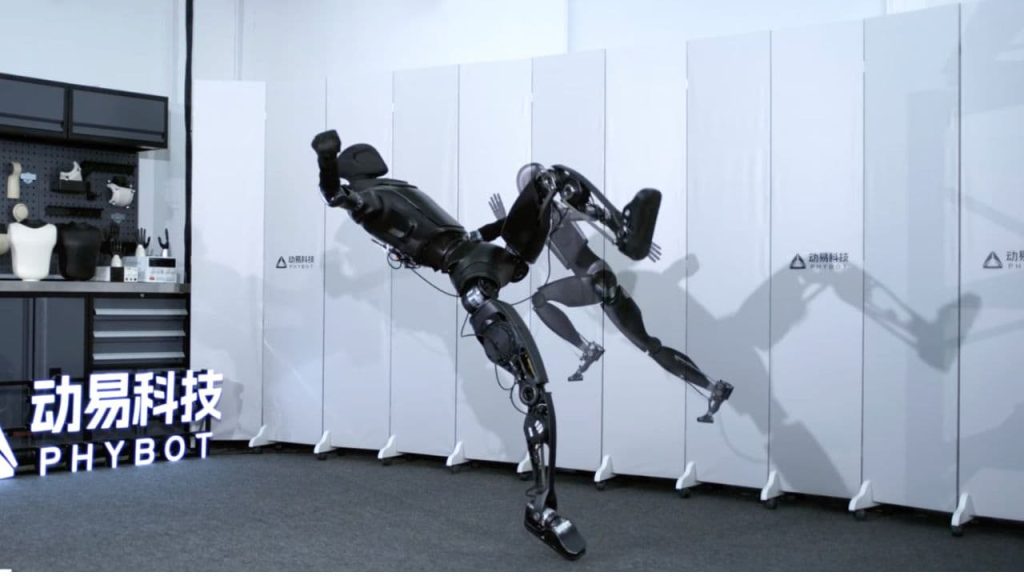
In an increasingly competitive humanoid robotics market, Chinese robotics company PHYBOT has made a powerful entry with its new full-sized electric humanoid, M1. Launched via a compelling YouTube video, the M1 robot impressed audiences by performing a standing backflip and an almost perfect ‘superman’ landing in a single take. While acrobatic feats have become a signature marketing move in humanoid robotics, pioneered by Boston Dynamics’ Atlas, PHYBOT leverages these stunts to highlight a critical differentiator: its high torque density advantage.
Founded by Tshinghua University alumni, CEO Ren Shiau and co-founder Mao Shuha, PHYBOT boldly claims the M1 to be the “most powerful humanoid robot ever created” and the “first full-sized electric humanoid to pull off a humanlike backflip.” These assertions position the M1 as a formidable contender designed for physically demanding tasks.
Unpacking the M1’s Robust Specifications
The PHYBOT M1 stands at an impressive 172 cm (5 feet 7 inches) and weighs under 60 kg (132 lbs). It’s built to navigate tough terrains, powered by a high-performance 72-volt system. At its core, the M1 boasts a sophisticated computing architecture, combining an Nvidia Jetson Orin with an Intel Core i7 processor, enabling rapid data processing essential for complex tasks.
For perception and navigation, the robot employs a reliable suite of sensors, including 3D LiDAR for accurate environmental mapping, stereo RGB cameras for depth perception and movement tracking, and an IMU (Inertial Measurement Unit) for maintaining balance and motion control. With 32 degrees of freedom (DoF) and dual 9Ah swappable batteries, the M1 offers over 2 hours of runtime.
The robot’s true power is evident in its ability to produce more than 10 kilowatts of power in one burst, which PHYBOT likens to giving a human-sized machine the instantaneous power of a motorcycle engine. Lab tests have shown the M1 achieving a peak joint torque of 530 N·m, demonstrating its exceptional strength, which enables smooth aerial launches and heavy lifting.
Engineered for Real-World Work, Not Just Demos
Beyond its dazzling acrobatics, the M1 is explicitly designed for practical, real-world applications. Its arms are capable of lifting between 10 and 20 kilograms, and its integrated backpack system can carry more than 50 kilograms, making it suitable for material handling, logistics, and other physically intensive industrial tasks. The high-dynamic stereo camera setup ensures superior vision, allowing the robot to accurately understand depth and movement in its surroundings, further supported by its high-performance onboard chip for quick data processing.
PHYBOT’s product line also includes the smaller C1 robot, launched in 2024 and marketed as an AI-powered companion, standing 128 cm tall and weighing 28 kg.
M1 vs. The Giants: A New Contender in the Humanoid Race
The M1 distinguishes itself with a remarkable power-to-weight ratio in a landscape populated by renowned humanoid robots. While Boston Dynamics’ Atlas is celebrated for its unparalleled agility and motion control, and Tesla’s Optimus is rapidly evolving with a focus on dexterity and safe, lightweight handling, PHYBOT’s M1 carves out a niche centered on strength and high lift capacity per joint. Unitree’s H1, meanwhile, prioritizes efficient locomotion. The PHYBOT M1 enters this arena as a strength-first contender, poised to tackle physically demanding tasks that require significant power and robust capabilities.
The Future of Humanoid Robotics is Strong
The PHYBOT M1 represents a significant leap forward in humanoid robotics, particularly in its emphasis on power and real-world applicability. By combining high torque density, advanced AI-powered perception, and robust physical design, the M1 promises to open new avenues for automation in industries requiring strong, agile, and intelligent robotic assistance. As humanoid robots continue to evolve, the M1’s introduction marks a pivotal moment, pushing the boundaries of what these machines can achieve in demanding operational environments.

CTO Robotics
CTO Robotics is a global media and consulting company dedicated to robotics, automation, artificial intelligence, and emerging technologies. We create high-impact content that reaches engineers, decision-makers, and innovators worldwide. Through articles, videos, social media campaigns, and community-driven storytelling, we help companies showcase their technologies, strengthen their brand, and connect with the right audience. Much like Interesting Engineering or Wevolver, our mission is to bridge the gap between technology providers and industry professionals — turning innovation into visibility, and visibility into growth. 👉 Whether you are launching a new product, building your brand, or looking for global recognition, CTO Robotics is your media partner for exposure, credibility, and business opportunities.
All stories by: CTO Robotics







0 Comments