
Introduction
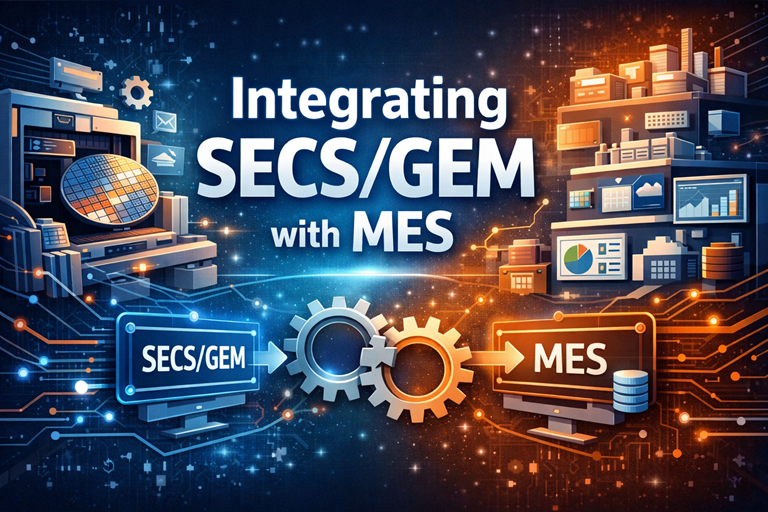
Modern semiconductor fabs operate in an environment where real-time data, automation, and standardization are critical to achieving high yield and operational efficiency. As fabs grow more complex, the need for seamless communication between production equipment and higher-level manufacturing systems becomes essential. This is where Integrating SECS/GEM with MES plays a pivotal role.
The SECS/GEM standard, defined by SEMI, enables standardized equipment communication, while a Manufacturing Execution System (MES) orchestrates production workflows, lot tracking, recipes, and quality control. Effective SECS/GEM MES integration ensures that data flows reliably from tools to MES and back, enabling smarter decisions and automated control.
This blog explores SECS GEM and MES communication, explains why it is crucial for modern fabs, and outlines SECS/GEM integration best practices to help manufacturers implement a robust and scalable solution.
Understanding SECS/GEM and MES in Semiconductor Fabs
Before diving into best practices, it is important to understand the roles of both systems in MES integration for semiconductor fabs.
SECS/GEM (SEMI Equipment Communications Standard / Generic Equipment Model) defines how manufacturing equipment reports status, events, alarms, and process data. MES, on the other hand, is the central brain of a semiconductor fab MES system, managing work-in-progress (WIP), dispatching, recipe control, genealogy, and compliance.
Integrating SECS/GEM with MES creates a standardized bridge between equipment-level data and factory-level execution. Through a well-defined SECS/GEM interface with MES, fabs gain consistent visibility into equipment states, production events, and process results across multiple tool vendors.
Why SECS/GEM MES Integration Is Critical
A well-executed SECS/GEM MES integration delivers measurable benefits across fab operations:
Real-time visibility – Equipment events and states are instantly available within the MES.
Improved automation – MES-driven commands can control tools using standard SECS GEM and MES communication.
Reduced manual intervention – Automated lot start, end, and tracking reduce human error.
Scalability – Standardized integration simplifies onboarding new tools and expansions.
Without proper MES integration for semiconductor fabs, manufacturers often face fragmented data, custom point-to-point interfaces, and high maintenance costs. Following proven SECS/GEM integration best practices helps avoid these pitfalls.
Best Practice 1: Define a Clear Integration Architecture
The foundation of Integrating SECS/GEM with MES is a clear and scalable architecture. Fabs should decide early whether the MES will communicate directly with equipment or through a SECS/GEM middleware for MES.
Middleware provides a dedicated MES SECS/GEM communication layer that:
Normalizes SECS-II messages
Manages multiple tool connections
Handles retries, buffering, and error recovery
This approach improves Semiconductor MES connectivity and reduces the complexity inside the MES itself. For large fabs with hundreds of tools, middleware-based Equipment to MES integration is considered an industry best practice.
Best Practice 2: Standardize Equipment Models and Message Mapping
One of the biggest challenges in SECS GEM and MES communication is variability between equipment suppliers. Even when tools are GEM-compliant, event IDs, variable definitions, and report structures can differ.
To ensure reliable integration of SECS/GEM with MES, fabs should:
Define standard equipment models
Create consistent event and variable mappings
Validate GEM compliance during tool acceptance
A standardized SECS/GEM interface with MES ensures that the MES interprets data consistently across lithography, etch, deposition, and metrology tools. This significantly improves Factory automation MES integration and long-term maintainability.
Best Practice 3: Focus on Event-Driven Communication
Event-driven integration is at the heart of effective SECS/GEM MES integration. Instead of polling equipment, MES should react to SECS/GEM events such as:
Control state changes
Process start and completion
Alarms and exceptions
Event-driven SECS GEM and MES communication reduces network load and enables real-time responses. For example, when a process completes, the MES can automatically update WIP, trigger inspection steps, or dispatch the next lot. This level of Tool automation using SECS/GEM is essential for high-throughput fabs.
Best Practice 4: Implement Robust Error Handling and Logging
In high-volume manufacturing, communication failures are inevitable. Successful MES integration for semiconductor fabs requires strong error-handling mechanisms.
Key recommendations include:
Centralized logging in the MES SECS/GEM communication layer
Automatic reconnection and message retry logic
Clear alarm propagation to MES
By designing fault-tolerant SECS/GEM middleware for MES, fabs can prevent minor communication issues from escalating into production downtime. Robust logging also simplifies root cause analysis and continuous improvement.
Best Practice 5: Secure and Govern the Integration
As fabs move toward smart manufacturing, integrating SECS/GEM with MES must also address security and governance. Equipment data often contains sensitive process information, making secure Semiconductor MES connectivity critical.
Best practices include:
Network segmentation between equipment and enterprise systems
Authentication and authorization at the middleware or MES level
Change management for SECS/GEM configurations
Secure and well-governed SECS/GEM MES integration protects intellectual property while enabling controlled automation.
Best Practice 6: Plan for Scalability and Future Expansion
Semiconductor manufacturing is constantly evolving. New tools, nodes, and fabs require integration solutions that scale easily. When planning to integrate SECS/GEM with MES, choose architectures that support:
Rapid onboarding of new equipment
Cloud or hybrid deployment models
Advanced analytics and AI use cases
A flexible semiconductor fab MES system combined with standardized SECS/GEM integration best practices ensures that today’s investment remains valuable tomorrow.
Measuring Success of SECS/GEM and MES Communication
To evaluate the effectiveness of SECS/GEM MES integration, fabs should track key performance indicators such as:
Reduction in manual operations
Improvement in equipment utilization
Accuracy of WIP and genealogy data
Faster root cause analysis
Consistent improvements in these metrics indicate that SECS GEM and MES communication is delivering real business value.
Integrating SECS/GEM with MES is no longer optional for modern semiconductor fabs—it is a strategic necessity. A well-designed SECS/GEM MES integration enables real-time visibility, higher automation, and scalable factory operations. By adopting proven SECS/GEM integration best practices, including standardized equipment models, middleware-based architectures, event-driven communication, and strong governance, manufacturers can unlock the full potential of their MES integration for semiconductor fabs.
As fabs continue their journey toward smart manufacturing and Industry 4.0, robust SECS GEM and MES communication will remain the backbone of efficient, data-driven production. Implemented correctly, it empowers fabs to improve yield, reduce costs, and stay competitive in an increasingly demanding semiconductor market.
einnosys
Einnosys is your reliable partner for cutting-edge semiconductor factory automation in India. Specializing in advanced SECS/GEM solutions and pioneering AI/ML innovations, we help optimize factory operations. As a leading software company, our expert team delivers efficient, customized solutions to enhance your manufacturing processes. Trust Einnosys for superior technology and unmatched industry expertise in the semiconductor sector.
All stories by: einnosys








0 Comments