
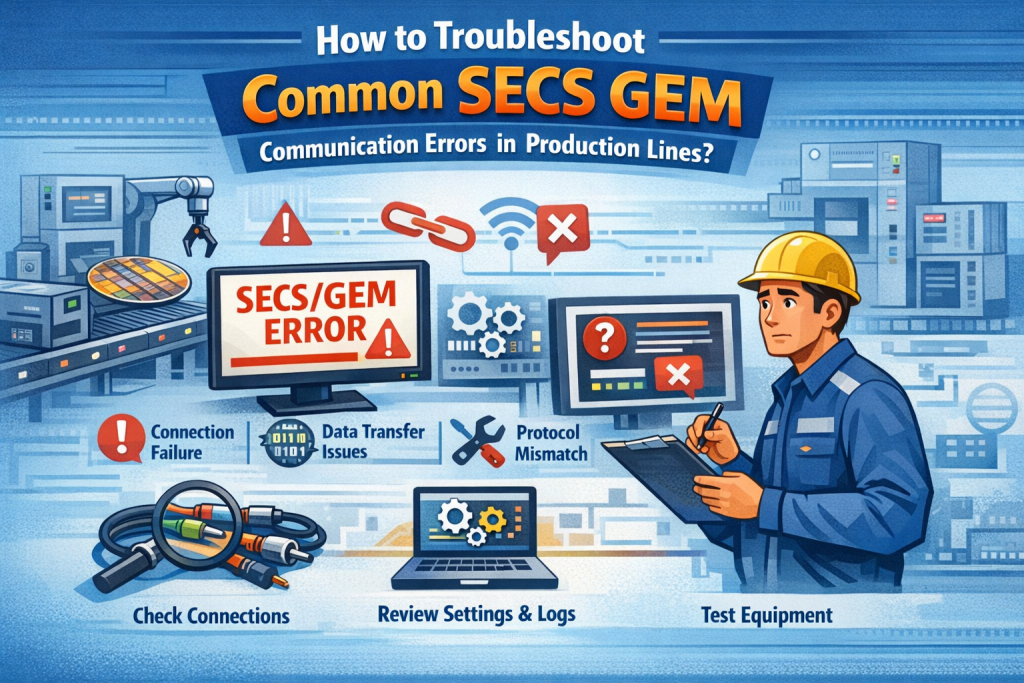
In modern semiconductor fabs, SECS/GEM production lines form the backbone of automated manufacturing. From equipment integration to real-time monitoring, Semiconductor equipment SECS/GEM enables standardized communication between tools and host systems. However, when communication fails, production efficiency, uptime, and compliance are immediately at risk. This is why SECS/GEM compliance is critical not only for fabs but also for SECS/GEM for equipment manufacturers supplying tools to global fabs.
This blog provides a practical, production-tested guide to identifying and resolving SECS/GEM issues in live environments. By understanding SECS/GEM standards, common failure modes, and proven SECS/GEM troubleshooting techniques, engineers can quickly restore stable Semiconductor equipment communication and maintain GEM compliance for semiconductor tools.
Understanding SECS/GEM Communication in Production Lines
Before diving into GEM protocol troubleshooting, it is essential to understand how SECS/GEM standards work in a fab environment. SECS (SEMI E4/E5) defines the message transport layer, while GEM (SEMI E30) defines behavior, state models, alarms, events, and data collection. Together, they ensure SECS/GEM compliance across heterogeneous tools.
In SECS/GEM production lines, equipment continuously exchanges messages such as:
- Establishing communication (S1F13/S1F14)
- Reporting equipment states
- Sending alarms and events
- Providing process and trace data
For SECS/GEM for equipment manufacturers, strict adherence to SECS/GEM standards ensures faster qualification and acceptance by fabs. Any deviation can result in frequent SECS/GEM communication errors, impacting OEE and integration timelines.
Common SECS/GEM Communication Errors in Production
1. Communication Establishment Failure
One of the most common SECS/GEM issues is the inability to establish communication between host and the equipment. Symptoms include repeated connection attempts or timeouts.
Root causes:
- Incorrect device ID or IP configuration
- Port mismatch or firewall blocking
- HSMS parameter mismatch (T3, T5, T7 timers)
SECS/GEM troubleshooting steps:
- Verify IP address, port, and device ID on both sides
- Confirm HSMS settings align with SECS/GEM standards
- Check firewall rules and network segmentation
Resolving these issues restores Semiconductor equipment communication and ensures GEM compliance for semiconductor tools in production.
2. Incorrect Equipment State Transitions
In SECS/GEM production lines, equipment states (IDLE, RUN, DOWN) must follow GEM rules. Incorrect state reporting is a frequent SECS/GEM communication error.
Root causes:
- Non-compliant state model implementation
- PLC logic not synchronized with GEM states
- Improper handling of remote/local modes
GEM protocol troubleshooting:
- Validate state transitions against SEMI E30
- Simulate host commands and observe responses
- Ensure PLC and GEM layers share a unified state model
Maintaining correct state behavior is essential for SECS/GEM compliance and seamless SECS/GEM for equipment manufacturers certification.
3. Alarm and Event Mismatch Errors
Alarms and events are central to Semiconductor equipment SECS/GEM communication. Missing or incorrectly reported alarms lead to production blind spots.
Root causes:
- Incorrect alarm IDs or event IDs
- Alarms not enabled or cleared properly
- Host expecting mandatory GEM events
SECS/GEM troubleshooting actions:
- Compare implemented alarms with host requirements
- Test alarm set and clear scenarios
- Ensure mandatory events are enabled per SECS/GEM standards
While often viewed negatively, resolving these SECS/GEM communication errors highlights the Benefits of SECS/GEM communication errors—they expose integration gaps early and improve long-term stability.
4. Data Collection and Variable Errors
Incorrect or missing data variables are common SECS/GEM issues affecting analytics, traceability, and OEE.
Root causes:
- Variable ID mismatch
- Incorrect data type mapping
- Unsupported variables requested by host
GEM protocol troubleshooting tips:
- Validate variable definitions against host documentation
- Confirm data types comply with SECS/GEM standards
- Test SVID and ECID responses thoroughly
Accurate data exchange strengthens Semiconductor equipment communication and supports SECS/GEM compliance across production lines.
Network and Infrastructure-Related Issues
5. Intermittent Communication Drops
Intermittent failures are among the hardest SECS/GEM communication errors to diagnose in live SECS/GEM production lines.
Root causes:
- Network latency or packet loss
- Unstable switches or cables
- Improper timeout configuration
SECS/GEM troubleshooting approach:
- Monitor network traffic during failures
- Increase HSMS timeout values where appropriate
- Isolate equipment on a dedicated VLAN
Reliable infrastructure is critical for GEM compliance for semiconductor tools and predictable production behavior.
6. Host–Equipment Version Mismatch
Different host systems may interpret SECS/GEM standards differently, leading to compatibility issues.
Root causes:
- Partial GEM implementation
- Custom host extensions
- Legacy equipment limitations
SECS/GEM troubleshooting best practice:
- Review host GEM requirement documents
- Perform compliance gap analysis
- Use simulation tools to validate behavior
For SECS/GEM for equipment manufacturers, proactive compatibility testing reduces integration delays and improves customer satisfaction.
Best Practices to Prevent SECS/GEM Communication Errors
Standardize Early
Implement SECS/GEM compliance during equipment design—not after delivery. Early standardization reduces costly rework.
Validate Against SEMI Standards
Continuously validate implementations against SECS/GEM standards using test cases and simulators.
Monitor in Real Time
Deploy monitoring tools to detect SECS/GEM issues before they escalate into downtime.
Document Everything
Maintain detailed documentation for alarms, events, variables, and states to simplify SECS/GEM troubleshooting.
By following these practices, fabs and OEMs can convert the benefits of SECS/GEM communication errors into learning opportunities that strengthen system robustness.
Why SECS/GEM Compliance Matters for Production Lines
In high-volume fabs, even minor SECS/GEM communication errors can cascade into significant losses. Strong SECS/GEM compliance ensures:
- Faster equipment qualification
- Predictable Semiconductor equipment communication
- Reduced downtime and faster recovery
- Long-term scalability of SECS/GEM production lines
- For SECS/GEM for equipment manufacturers, compliance is not optional—it is a market requirement for global fabs.
Conclusion
Troubleshooting SECS/GEM communication errors in production lines requires a structured approach grounded in SECS/GEM standards and real-world operational insight. From connection failures and alarm mismatches to data errors and network instability, most SECS/GEM issues can be resolved with systematic GEM protocol troubleshooting.
By prioritizing SECS/GEM compliance, validating behavior early, and continuously monitoring Semiconductor equipment SECS/GEM interactions, fabs and OEMs can maintain stable, high-performing SECS/GEM production lines. Ultimately, robust GEM compliance for semiconductor tools transforms communication challenges into a competitive advantage—delivering higher OEE, lower downtime, and faster innovation across the semiconductor manufacturing ecosystem.

einnosys
Einnosys is your reliable partner for cutting-edge semiconductor factory automation in India. Specializing in advanced SECS/GEM solutions and pioneering AI/ML innovations, we help optimize factory operations. As a leading software company, our expert team delivers efficient, customized solutions to enhance your manufacturing processes. Trust Einnosys for superior technology and unmatched industry expertise in the semiconductor sector.
All stories by: einnosys










0 Comments