
Introduction
As semiconductor fabrication facilities evolve into highly automated, data-driven environments, real-time visibility into equipment behavior has become a competitive necessity rather than a nice-to-have. Smart fabs rely on continuous data streams to maintain uptime, improve yield, and identify problems before they escalate into costly downtime. At the heart of this transformation is SECS/GEM real-time equipment monitoring, a standardized framework that allows equipment and factory host systems to communicate seamlessly. By enabling accurate status reporting, event notifications, and equipment control, SECS/GEM smart fab monitoring forms the backbone of modern semiconductor manufacturing operations.
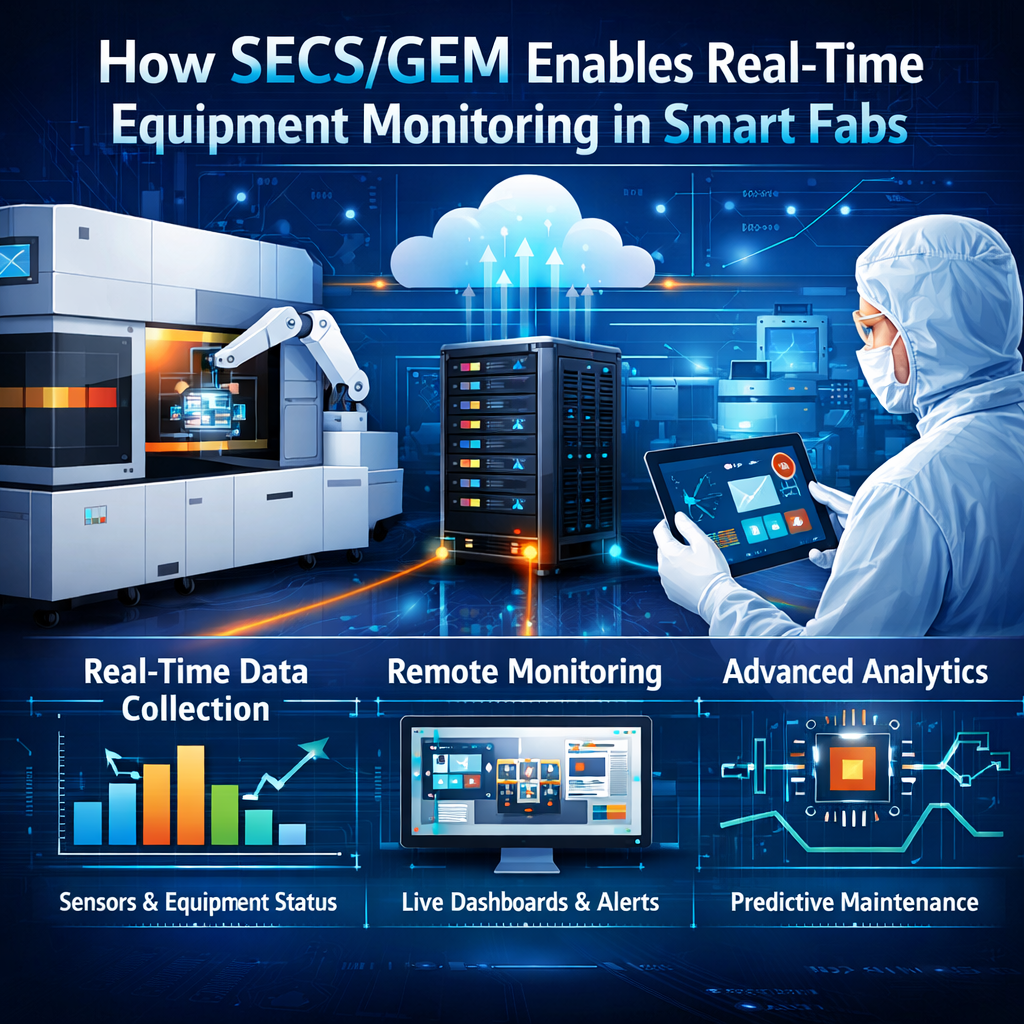
From tool utilization tracking to fault detection, SECS/GEM equipment monitoring supports the foundational goal of smart factories: making informed decisions based on trustworthy, real-time data. This article explores how SECS/GEM functions, how it integrates into advanced fabs, and why it remains critical for next-generation semiconductor equipment monitoring strategies.
Understanding SECS/GEM in the Smart Fab Context
SECS (Semiconductor Equipment Communication Standard) and GEM (Generic Equipment Model) together define how manufacturing equipment exchanges information with host systems. SECS/GEM integration for smart fabs standardizes equipment communication so tools from different vendors can speak a common language. This capability is essential for scaling automation and eliminating proprietary interfaces.
In practice, SECS/GEM communication handles message exchanges covering commands, reports, and acknowledgments between equipment and manufacturing execution systems (MES). Through structured message formats and predefined models, fabs can implement Equipment host communication using SECS/GEM without reinventing interfaces for each tool. As a result, equipment can be brought online faster and integrated more reliably into fab-wide monitoring systems.
Furthermore, SECS/GEM data collection forms the basis for operational analytics. By consistently collecting process parameters, equipment states, and events, fabs gain the visibility required for advanced control and optimization. This approach enables scalable Semiconductor equipment monitoring, even as tool complexity and fab size grow.
Enabling Real-Time Visibility with SECS/GEM
Real-time visibility is the cornerstone of smart fab operations. SECS/GEM real-time equipment monitoring allows host systems to receive instantaneous updates on tool status changes, alarms, and operational conditions. This immediate feedback loop is critical for maintaining high equipment availability and meeting production targets.
Using SECS/GEM equipment status monitoring, tools report defined states such as idle, processing, or alarmed. These standardized state models ensure consistent interpretation across systems and vendors. Combined with SECS/GEM alarms and events, fabs gain proactive alerting mechanisms that help engineers respond before minor issues become yield-impacting failures.
Access to Real-time equipment data in semiconductor fabs also enables advanced automation scenarios. Automated material handling systems, dispatching logic, and recipe management tools can react instantly to equipment conditions. The result is a synchronized production environment where decisions are based on live data rather than delayed reports.
By leveraging SECS/GEM smart fab monitoring, fabs reduce manual intervention, improve mean time to repair (MTTR), and create a data-driven foundation for continuous improvement initiatives.
Driving Operational Efficiency Through Data Collection and Events
Beyond basic monitoring, the true value of SECS/GEM lies in structured data and event handling. SECS/GEM data collection allows fabs to define precisely what information is reported and when. Whether it’s periodic variable sampling or event-triggered reporting, hosts can obtain timely, meaningful data without overwhelming systems with noise.
SECS/GEM alarms and events play a crucial role in equipment health management. When tools generate alarms for abnormal conditions, host systems can automatically log incidents, notify engineers, or trigger automated workflows. This capability strengthens GEM-compliant equipment monitoring, ensuring consistency across toolsets and enabling factory-wide alarm management strategies.
Additionally, Equipment host communication using SECS/GEM allows hosts to request reports on-demand, supporting root cause analysis and performance tracking. Over time, collected data contributes to predictive maintenance initiatives, further enhancing Semiconductor equipment monitoring effectiveness across the fab.
When combined with analytics platforms, SECS/GEM real-time equipment monitoring transforms raw data into actionable insights, driving measurable improvements in throughput and yield.
SECS/GEM Integration for Advanced Smart Fab Architectures
As fabs adopt Industry 4.0 concepts, SECS/GEM integration for smart fabs becomes a critical enabler of digital transformation. Integration extends beyond basic connectivity to include orchestration with MES, fault detection and classification (FDC), and advanced process control (APC) systems.
Through standardized SECS/GEM communication, equipment data flows reliably into higher-level applications. SECS/GEM equipment monitoring ensures that digital twins and AI-driven optimization tools are fed with accurate, real-time information. Without this reliable backbone, advanced analytics would be built on incomplete or inconsistent data.
Moreover, SECS/GEM smart fab monitoring simplifies onboarding of new equipment. GEM-compliant tools adhere to well-defined behaviors, reducing engineering effort during startup and validation. This consistency accelerates fab expansion and supports rapid technology node transitions.Ultimately, Real-time equipment data in semiconductor fabs empowers cross-functional teams—from production to maintenance—to collaborate using a shared, trustworthy data source.
Conclusion
In the era of smart manufacturing, real-time insight into equipment behavior is non-negotiable. SECS/GEM real-time equipment monitoring delivers the standardized communication, structured data collection, and event-driven visibility required for advanced semiconductor operations. By enabling SECS/GEM equipment status monitoring, alarms, and events, fabs gain proactive control over equipment performance and reliability.
As SECS/GEM integration for smart fabs continues to support automation, analytics, and scalability, it remains a cornerstone of modern Semiconductor equipment monitoring strategies. Whether improving operational efficiency, enabling predictive maintenance, or supporting future AI-driven initiatives, SECS/GEM smart fab monitoring ensures that real-time data remains accessible, accurate, and actionable.
For fabs aiming to stay competitive in an increasingly complex manufacturing landscape, investing in robust, GEM-compliant equipment monitoring is not just an option—it is a strategic imperative.

einnosys
Einnosys is your reliable partner for cutting-edge semiconductor factory automation in India. Specializing in advanced SECS/GEM solutions and pioneering AI/ML innovations, we help optimize factory operations. As a leading software company, our expert team delivers efficient, customized solutions to enhance your manufacturing processes. Trust Einnosys for superior technology and unmatched industry expertise in the semiconductor sector.
All stories by: einnosys










0 Comments