
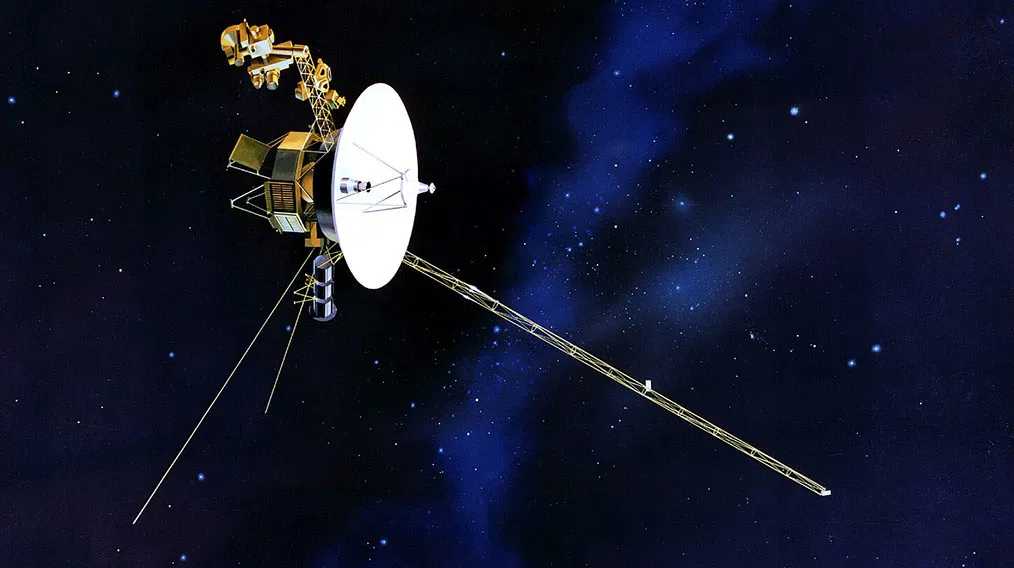
In a testament to human ingenuity and enduring engineering, NASA’s venerable Voyager 1 spacecraft is poised to achieve another monumental milestone. By late 2026, this pioneering probe, already humanity’s most distant creation, is expected to become the first human-made object to reach a staggering distance of one light-day from Earth.
A Journey of Unprecedented Scale
Imagine a distance so vast that it takes light itself a full 24 hours to traverse it. That’s the extraordinary benchmark Voyager 1 is nearing. Currently, radio signals from Earth take approximately 23 hours, 32 minutes, and 35 seconds to reach the spacecraft, which is presently 15.7 billion miles (25.3 billion km) away. By around November 15, 2026, as Voyager 1 travels further to 16.1 billion miles (25.9 billion km), this communication delay will stretch to an entire day.
This impending milestone underscores the immense scale of deep space exploration. While we often discuss light-years, the concept of a ‘light-day’ brings into sharp focus the extraordinary distances involved and the incredible longevity of a mission that launched nearly half a century ago.
The Engineering Marvel of Voyager’s Legacy
Voyager 1 and its twin, Voyager 2, launched in 1977, were designed for a grand tour of the outer planets. They have far exceeded their planned lifespans, operating for almost 50 years with onboard memory a fraction of a modern smartphone’s. Their continued functionality is a profound demonstration of robust system integration, resilient hardware, and masterful remote management.
These robotic explorers were instrumental in providing unprecedented close-up views of Jupiter and Saturn, and Voyager 1 famously captured the iconic ‘pale blue dot’ image of Earth. Both spacecraft have since ventured into interstellar space – the only two human-made objects to do so – continuing to transmit invaluable scientific data about the cosmic environment beyond our solar system’s heliosphere.
Communicating Across the Void
As Voyager 1 pushes further into the interstellar medium, communication becomes an increasingly intricate dance. NASA’s Deep Space Network remains the lifeline, sending commands and receiving telemetry across billions of miles. The one-light-day distance means that any command sent from Earth will take 24 hours to reach the probe, and another full day will pass before confirmation of that command’s execution can be received back on Earth. This latency highlights the incredible autonomy required of such robotic missions and the sophisticated algorithms necessary for their continued operation.
Though Voyager 1’s nuclear power source is estimated to keep it operational for only another year or so beyond this milestone, its journey continues to inspire. It stands as a powerful symbol of humanity’s drive to explore, to understand, and to push the boundaries of technology and scientific discovery, even in the most extreme and distant environments.
Connect with the CTO ROBOTICS Media Community
Follow us and join our community channels for the latest insights in AI, Robotics, Smart Manufacturing and Smart Tech.


CTO Robotics
CTO Robotics is a global media and consulting company dedicated to robotics, automation, artificial intelligence, and emerging technologies. We create high-impact content that reaches engineers, decision-makers, and innovators worldwide. Through articles, videos, social media campaigns, and community-driven storytelling, we help companies showcase their technologies, strengthen their brand, and connect with the right audience. Much like Interesting Engineering or Wevolver, our mission is to bridge the gap between technology providers and industry professionals — turning innovation into visibility, and visibility into growth. 👉 Whether you are launching a new product, building your brand, or looking for global recognition, CTO Robotics is your media partner for exposure, credibility, and business opportunities.
All stories by: CTO Robotics










0 Comments