

Video Friday is your weekly selection of awesome robotics videos, collected by your friends at IEEE Spectrum robotics. We also post a weekly calendar of upcoming robotics events for the next few months. Please send us your events for inclusion.
ICRA 2026: 1–5 June 2026, VIENNA
RSS 2026: 13–17 July 2026, SYDNEY
Summer School on Multi-Robot Systems: 29 July–4 August 2026, PRAGUE
Enjoy today’s videos!
Sony AI’s latest research, published on the cover of Nature, addresses a long-standing challenge in physical AI: Can a high-speed autonomous system master the complex perception and dynamic control required to compete against professional athletes?
[ Sony AI ]
In this video, we present Ringbot Quad, a novel monocycle robot with four legs that combines wheeled and legged locomotion on a single platform. Ringbot Quad is designed as a unique monocycle mechanism that replaces the traditional drivetrain with four individually actuated driving modules, each integrated with an articulated leg.
Ringbot Quad aims to provide versatile and efficient mobility through two distinct locomotion modes. In driving mode, the four legs assist with balance and steering, while in walking mode, they fully support the body for quadruped locomotion. By switching between these modes, Ringbot Quad can navigate diverse terrains and overcome obstacles that are difficult for either wheeled or legged systems alone.
[ Kinetic Intelligent Machine Lab ]
Humanoid robots have beaten human runners in a Beijing half-marathon, marking a breakthrough in China’s rapidly advancing robotics industry. More than 100 robots competed alongside 12,000 people in the 21-kilometer race, with three crossing the finish line ahead of any human.
[ Al Jazeera ]
Watch AthenaZero juggle barehanded using on-board sensory feedback only. No motion capture. No funnels. No help adding the third ball. The robot learns to adapt to the uncertainties from contact and the appropriate hand-eye coordination.
From the look of this, it’s based on data capture from humans. What I want to know is, what this will look like when it’s not based on data capture from humans.
[ Unitree ]
Looks like Sphero would like to fill that sad gap in educational robotics left by LEGO Mindstorms.
[ Sphero ]
I am pretty sure that this is not how the shell game is played.
[ Generalist ]
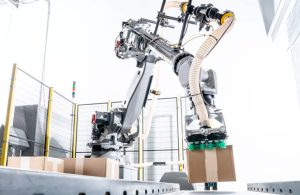
At this point, real value from robots in warehouses much more commonly comes from systems like these, not humanoids.
[ Berkshire Grey ]
Scientists at the Max Planck Institute for Intelligent Systems propose a method to measure the efficiency of soft electrostatic actuators, enabling systematic evaluation of electrical-to-mechanical energy conversion. Using Peano-HASEL actuators, they demonstrate efficiencies up to 63.6%, over three times higher than previously reported, and validate the approach across other actuator types, paving the way for more energy-efficient soft electrostatic robotic systems.
Already deployed in North America, quadruped robots provide continuous patrol, real-time monitoring, and faster incident detection across residential communities—day and night.
Um, thanks, but no thanks.
[ DEEP Robotics ]
Catching drones with what looks like a UR20 robot arm is a neat trick.
[ Skydio ]
Overactuated drones performing aerial maneuvers will always look just a little bit wrong to me.
[ Paper ] from [ ETH Zurich ]
Need a rugged and reliable mobile manipulator? Please consider a not-humanoid.
[ Clearpath ]
This CMU Robotics Institute talk is from CMU’s Raj Reddy, on “The Future of AI : Doomers vs. Abundance.”
The last decade has seen extraordinary advances in AI. The potential arrival of Artificial General Intelligence (AGI) has profound implications for future of our society. We anticipate a world where AI assistants and humanoid robots will perform most of the tasks requiring human expertise and skill at 10% of current costs. In this paradigm, essential services—including food, housing, energy, education, healthcare, and transportation—will be provided via Universal Basic Services, signaling a historic shift from a society of scarcity to one of abundance. This transformation raises a critical concern: widespread displacement of traditional labor. What is the human role when AI can do everything? This talk presents an alternative scenario: a “Human-in-the-Loop” evolution. In this model, humans transition into high-level supervisory roles, collaborating with AGI to train robots in novel skills and adapt them to unforeseen tasks.
We explore this as the “Maharaja Model” where technology serves humanity so comprehensively that work will be optional for humans. Finally, we will discuss how institutions like the Robotics Institute must lead this transition, developing the hybrid technologies and ethical frameworks necessary to bridge the gap between our current economy and a robot-assisted future.

CTO Robotics
CTO Robotics is a global media and consulting company dedicated to robotics, automation, artificial intelligence, and emerging technologies. We create high-impact content that reaches engineers, decision-makers, and innovators worldwide. Through articles, videos, social media campaigns, and community-driven storytelling, we help companies showcase their technologies, strengthen their brand, and connect with the right audience. Much like Interesting Engineering or Wevolver, our mission is to bridge the gap between technology providers and industry professionals — turning innovation into visibility, and visibility into growth. 👉 Whether you are launching a new product, building your brand, or looking for global recognition, CTO Robotics is your media partner for exposure, credibility, and business opportunities.
All stories by: CTO RoboticsRelated Posts
-
 July 24, 2025
The Benefits of Robotic Grinding and Finishing












0 Comments