
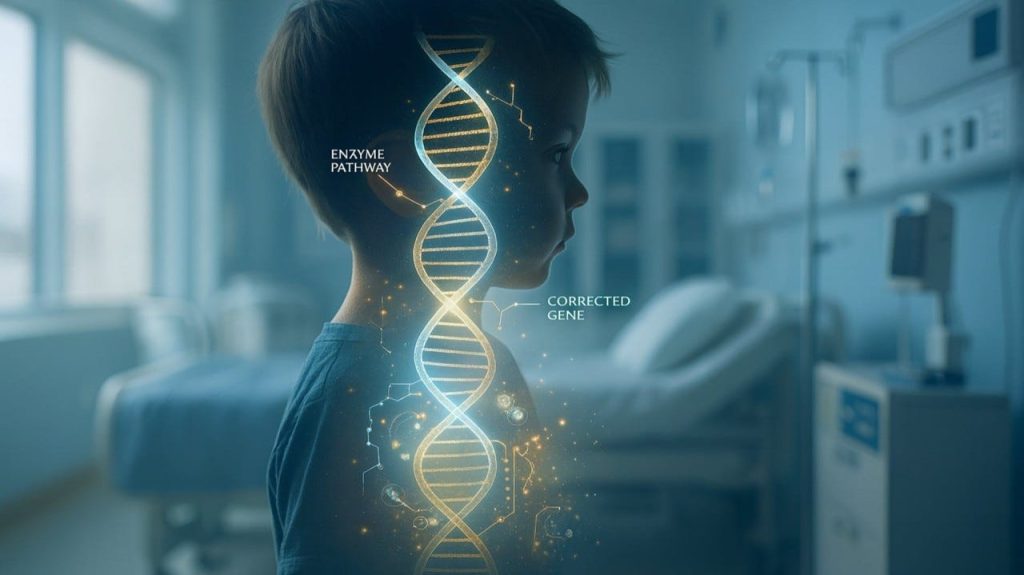
In a landmark achievement underscoring the incredible potential of advanced biological engineering, a three-year-old boy named Oliver Chu has become the world’s first patient to receive a revolutionary stem cell gene therapy for Hunter syndrome (mucopolysaccharidosis type II or MPS II).
This rare, inherited disorder has devastating effects, often likened to childhood dementia, significantly limiting life expectancy. The groundbreaking, one-off procedure, developed over a decade at the University of Manchester and trialed at the Royal Manchester Children’s Hospital (RMCH), offers a beacon of hope where previous treatments fell short.
The Challenge of Hunter Syndrome and the Power of Precision Engineering
Hunter syndrome is caused by a faulty gene, preventing the body from producing a vital enzyme. Without this enzyme, toxic sugar molecules accumulate in organs and tissues, leading to progressive damage, including severe cognitive decline. Existing treatments, like the costly, weekly Enzyme Replacement Therapy (ERT) called Elaprase, can manage physical symptoms but are ineffective at crossing the blood-brain barrier to address neurological damage.
This is where the new gene therapy marks a profound leap forward. Professor Rob Wynn, Consultant Paediatric Haematologist and Director of Paediatric Bone Marrow Transplant Programme at RMCH, highlights its advantages: “Gene therapy is not only safer and more effective, but it enables us to use the child’s own cells, which cuts out the need to find a donor, and means we can produce more enzyme for the patient.”
Engineering Health: How the Therapy Works
The innovative treatment involves a meticulous process of cellular engineering: a patient’s own stem cells are extracted, their faulty gene is corrected in a laboratory setting, and these modified, enzyme-producing cells are then re-injected back into the patient. Crucially, these engineered stem cells can produce high levels of the missing enzyme and, unlike previous treatments, reach the brain to break down the toxic sugar build-up, potentially preventing dementia-like decline.
Months after receiving the therapy in February 2025, Ollie has made a full recovery from the transplant. Professor Simon Jones, Consultant in Paediatric Inherited Metabolic Disease at the Manchester Centre for Genomic Medicine, notes, “Instead of seeing levels of the previously missing enzyme dropping we are seeing very high levels in his blood, and this is an extremely encouraging sign that the treatment is working.”
A Blueprint for the Future of Medical Technology
For us at ctorobotics.com, while this isn’t a direct robotics story, it exemplifies the highest forms of advanced technological application and precision engineering. The ability to manipulate and reprogram biological systems at a cellular level mirrors the complex control and integration challenges found in advanced robotics and automation.
The success of this blood cell gene therapy approach is a profound blueprint for treating a multitude of other genetic conditions. This future of highly personalized, precise medical interventions will undoubtedly be further enabled and scaled by technologies like AI for genomic analysis and treatment planning, and sophisticated medical and surgical robots for therapeutic delivery and monitoring. As Ollie’s father, Ricky Chu, shares, “We’re excited for Ollie’s future. Seeing the difference for Ollie pre-and post-transplant has made us believers.” This breakthrough stands as a testament to human ingenuity, pushing the boundaries of what advanced technology can achieve in improving and saving lives.
Connect with the CTO ROBOTICS Media Community
Follow us and join our community channels for the latest insights in AI, Robotics, Smart Manufacturing and Smart Tech.


CTO Robotics
CTO Robotics is a global media and consulting company dedicated to robotics, automation, artificial intelligence, and emerging technologies. We create high-impact content that reaches engineers, decision-makers, and innovators worldwide. Through articles, videos, social media campaigns, and community-driven storytelling, we help companies showcase their technologies, strengthen their brand, and connect with the right audience. Much like Interesting Engineering or Wevolver, our mission is to bridge the gap between technology providers and industry professionals — turning innovation into visibility, and visibility into growth. 👉 Whether you are launching a new product, building your brand, or looking for global recognition, CTO Robotics is your media partner for exposure, credibility, and business opportunities.
All stories by: CTO Robotics










0 Comments