
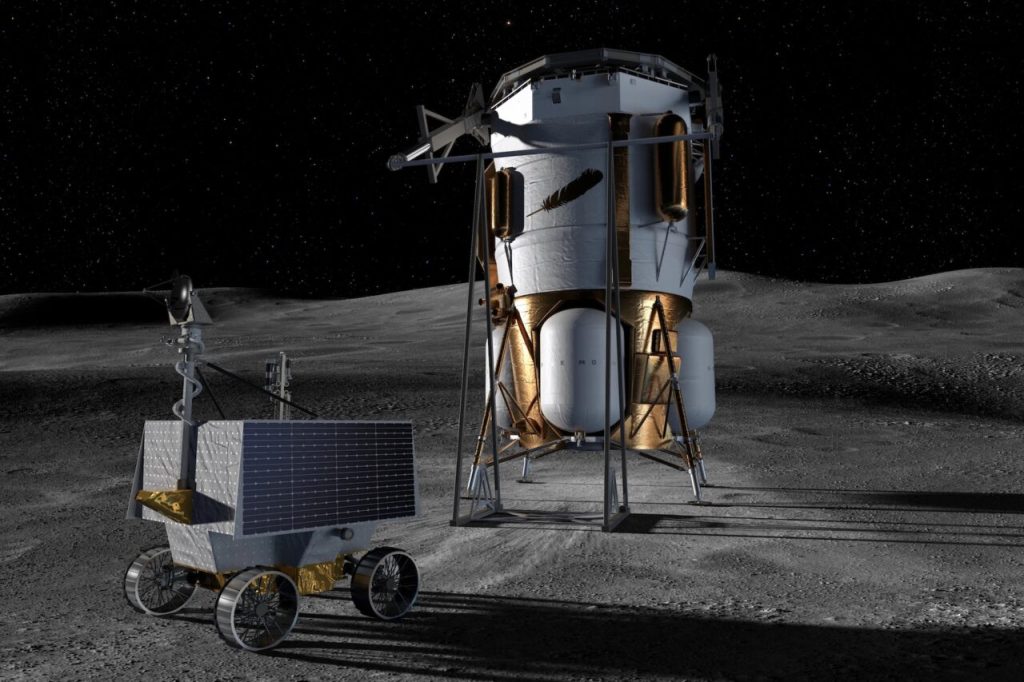
The private space race is heating up, and Blue Origin is making a bold play for the Moon. Jeff Bezos’ aerospace company recently celebrated the inaugural orbital flight of its New Glenn rocket and has now unveiled its Mark 1 (MK1) lunar lander, setting an ambitious target for an uncrewed Moon landing in early 2026. This swift progress positions Blue Origin as a formidable challenger in the lunar arena, directly competing with SpaceX and potentially reshaping NASA’s Artemis program.
The Race to Shackleton Crater
Blue Origin’s MK1 lander is designed for precision and resilience. Standing over 26 feet tall, this uncrewed vehicle is slated to touch down near the Shackleton crater at the Moon’s south pole—a region of significant scientific interest due to its potential for water ice. If successful, this mission, dubbed ‘Blue Moon Pathfinder,’ would represent a monumental achievement for Blue Origin, potentially placing them on the lunar surface before their main competitor, SpaceX.
The company plans to demonstrate and validate MK1’s critical hardware and systems, including its propulsion, avionics, and the powerful BE-7 engine. The mission will also carry NASA’s SCALPSS (Stereo Cameras for Lunar Plume Surface Studies) instrument, gathering crucial data on lunar landing dynamics, an essential step for future crewed missions.
A Historic Opportunity: Blue Origin and Artemis
The path to the Moon has been marked by twists and turns. Blue Origin previously challenged NASA’s decision to award SpaceX the lucrative lunar lander contract for the Artemis program. While that lawsuit was ultimately unsuccessful, the current landscape presents a dramatic shift.
SpaceX’s Starship Human Landing System (HLS) has faced significant delays, particularly due to the complexities of on-orbit refueling, pushing back NASA’s Artemis 3 mission (the first crewed lunar landing since Apollo 17) to 2028. This provides a critical window for Blue Origin. With NASA actively exploring alternatives, a successful 2026 MK1 landing could dramatically boost Blue Origin’s standing, making them a strong contender to potentially ferry Artemis astronauts to the Moon.
Engineering the Lunar Frontier: MK1’s Capabilities and Challenges
Landing on the Moon is an immense challenge, as recent events with Intuitive Machines’ Odysseus lander and Russia’s Luna-25 mission have starkly reminded the world. Blue Origin’s MK1, while smaller than its future MK2 counterpart, is larger than the historic Apollo landers, providing more potential payload capacity (up to 3.3 tons) for scientific instruments or future human support systems. However, its height also presents increased risks for tipping during touchdown, demanding sophisticated automation and control systems.
The development of lunar landers like MK1 highlights the pinnacle of robotics and automation engineering. From autonomous navigation and guidance systems to robust propulsion control and real-time sensor processing, these missions are a testament to advanced system integration and safety protocols. Blue Origin’s upcoming fully integrated checkout tests will be crucial for validating these complex systems, preparing the MK1 for its groundbreaking journey.
As the countdown to early 2026 begins, the aerospace world watches keenly. Blue Origin’s aggressive timeline and advanced robotic lander not only intensify the private space race but also offer a compelling narrative for the future of lunar exploration, potentially accelerating humanity’s return to the Moon.

CTO Robotics
CTO Robotics is a global media and consulting company dedicated to robotics, automation, artificial intelligence, and emerging technologies. We create high-impact content that reaches engineers, decision-makers, and innovators worldwide. Through articles, videos, social media campaigns, and community-driven storytelling, we help companies showcase their technologies, strengthen their brand, and connect with the right audience. Much like Interesting Engineering or Wevolver, our mission is to bridge the gap between technology providers and industry professionals — turning innovation into visibility, and visibility into growth. 👉 Whether you are launching a new product, building your brand, or looking for global recognition, CTO Robotics is your media partner for exposure, credibility, and business opportunities.
All stories by: CTO Robotics







0 Comments