
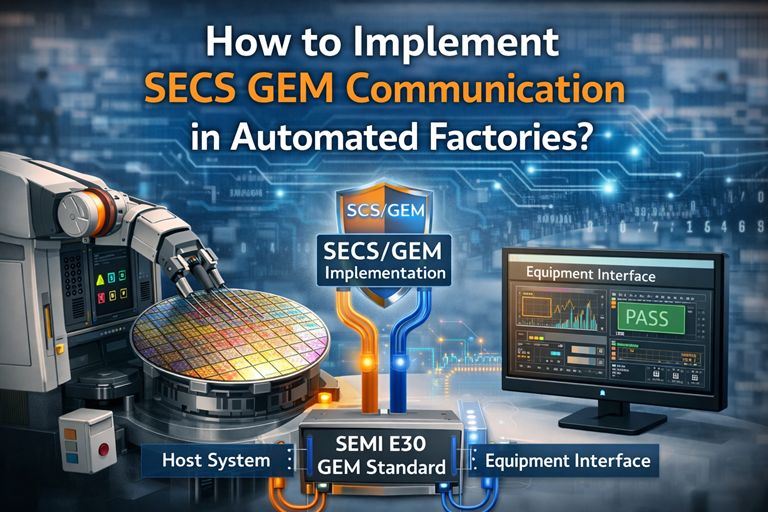
As automated factories become the backbone of modern semiconductor manufacturing, standardized equipment communication is critical for efficiency, reliability, and scalability. SECS GEM communication provides a proven framework that enables seamless interaction between factory host systems and production equipment. Implementing it correctly ensures stable automation, real-time visibility, and compliance with industry standards.
Understanding SECS/GEM Protocol Basics
The SECS/GEM protocol is a set of SEMI standards designed to standardize communication between semiconductor equipment and factory hosts. It defines how data, commands, events, and alarms are exchanged in a consistent manner. SECS GEM implementation eliminates custom integrations and simplifies multi-vendor equipment communication across the factory floor.
At the foundation of SECS GEM automation are communication layers such as SECS-I and HSMS communication, which handle the transport of messages between systems. HSMS is widely used in modern factories due to its speed and reliability.
Step 1: Define Factory Integration Requirements
Successful SECS GEM factory integration starts with understanding operational requirements. This includes identifying what data needs to be collected, which events must be reported, and how the factory host will control equipment. Clear requirements help determine the scope of SECS GEM manufacturing communication and avoid integration gaps later.
Step 2: Implement GEM Interface Software
Reliable SECS GEM interface software acts as the bridge between equipment control systems and factory host applications. This software handles message formatting, communication sessions, error handling, and protocol compliance. Selecting a robust interface layer is essential for long-term system stability and scalability.
Step 3: Integrate Equipment Interfaces
Each tool must expose a compliant SECS GEM equipment interface that maps machine states, alarms, and process data to GEM definitions. Proper SECS GEM equipment integration ensures that equipment behavior aligns with host expectations and automation workflows.
During this stage, engineers define the SECS GEM message flow, ensuring that commands, responses, and data transfers occur in the correct sequence.
Step 4: Configure State Models and Reporting
The SECS GEM state model defines how equipment transitions between operational states such as idle, running, and error. Accurate state modeling is critical for host visibility and production control.
Additionally, SECS GEM alarm and event reporting must be configured to notify the host of abnormal conditions and key process events. These mechanisms support faster troubleshooting and improve overall equipment effectiveness.
Step 5: Enable Recipe and Data Management
Automation relies heavily on consistent process execution. SECS GEM recipe management allows hosts to upload, download, and verify process recipes, reducing human error and ensuring repeatability.
At the same time, SECS GEM data collection enables continuous monitoring of process parameters, performance metrics, and historical trends, supporting analytics and optimization initiatives.
Step 6: Perform Compliance Testing
Before deployment, thorough SECS GEM compliance testing is essential. This ensures alignment with the SEMI E30 GEM standard and validates correct communication behavior under normal and exception conditions. Testing reduces integration risks and accelerates factory acceptance.
Conclusion
Implementing SECS GEM communication in automated factories requires a structured approach that combines protocol understanding, reliable interface software, and disciplined testing. When executed properly, SECS/GEM enables scalable automation, improves equipment interoperability, and provides the foundation for data-driven manufacturing operations.
By following best practices in SECS GEM industrial automation, factories can achieve higher efficiency, improved visibility, and long-term integration success.
einnosys
Einnosys is your reliable partner for cutting-edge semiconductor factory automation in India. Specializing in advanced SECS/GEM solutions and pioneering AI/ML innovations, we help optimize factory operations. As a leading software company, our expert team delivers efficient, customized solutions to enhance your manufacturing processes. Trust Einnosys for superior technology and unmatched industry expertise in the semiconductor sector.
All stories by: einnosys










0 Comments