
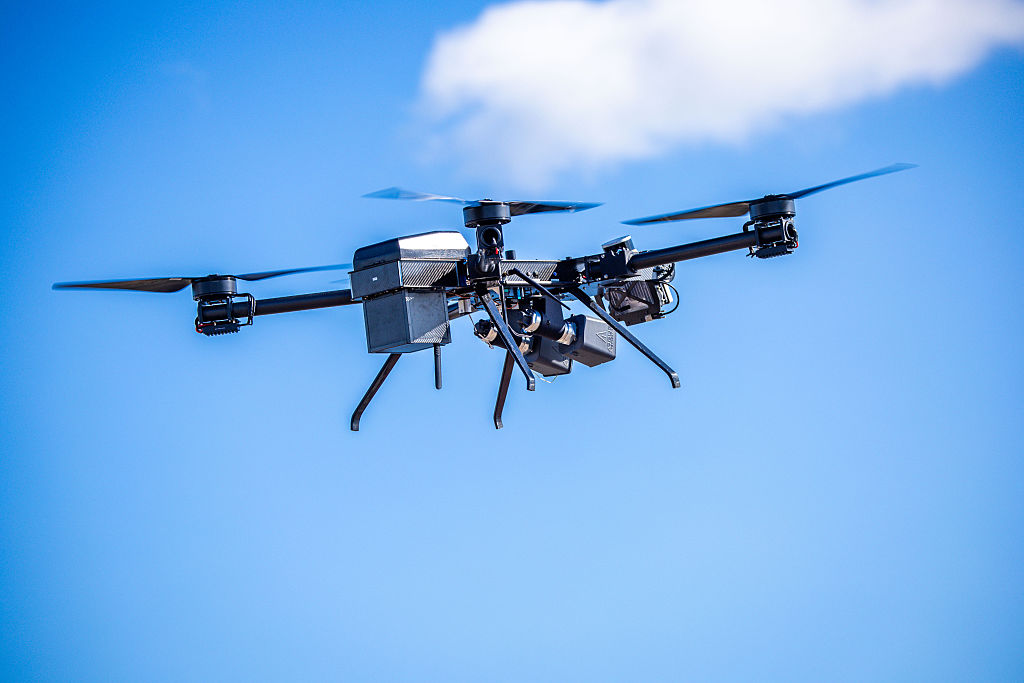
The proliferation of unmanned aerial vehicles (UAVs), commonly known as drones, has ushered in an unprecedented era of convenience and innovation. However, with this accessibility comes a significant and growing threat: rogue drones breaching restricted airspace. From disrupting airport operations to potentially carrying illicit payloads into secure facilities, unauthorized UAVs pose a serious civil security challenge. Addressing this escalating concern, researchers at Germany’s Julius Maximilian University of Würzburg have developed a groundbreaking autonomous interceptor drone, poised to revolutionize how critical infrastructure and public spaces are protected.
Pioneering Autonomous Airspace Defense
The journey to develop this sophisticated interceptor began in 2017 under the MIDRAS project, focusing on fundamental detection, tracking, and interception methods. This foundational work culminated in a successful proof-of-concept demonstration in 2020. Building on these critical insights, the project advanced into the flagship IDAS (Innovative Drone Defence System) initiative, transforming the early prototype into a fully functional and robust interceptor drone system.
A pivotal design decision, made in close consultation with police officers who would be the primary end-users, was to opt for a single, larger interceptor drone rather than a coordinated fleet. Dr. Julian Rothe, a research assistant at the university’s computer science department, explained that this approach significantly simplifies deployment and enhances operational reliability in real-world scenarios. “This setup meets practical requirements much more effectively,” Rothe affirmed, highlighting the system’s user-centric design.
The IDAS system boasts an impressive autonomous target acquisition capability. It employs advanced LiDAR sensors for initial detection of potential intruders. Once a target is identified, an onboard camera, powered by sophisticated AI-based recognition algorithms, verifies its identity. This crucial step differentiates genuine drone threats from harmless objects like birds, preventing false positives and ensuring precise engagement. After verification, the interceptor autonomously maneuvers into the optimal position for capture.
Precision Net Capture and Forensic Integrity
The core of the Würzburg interceptor’s efficacy lies in its unique capture mechanism. As it closes in on its target, the interceptor drone deploys an extendable net mid-flight. This high-speed net is designed to safely entrap the unauthorized drone with minimal damage. The emphasis on minimizing damage is paramount, as security agencies often require the captured drone to remain intact for crucial forensic analysis. This allows investigators to trace the drone’s origin, identify its operator, and understand its intended mission, which is vital for law enforcement and national security.
Once captured, the rogue drone is not simply brought down, but rather carried by the interceptor to a predefined, secure landing zone. This controlled retrieval process further ensures both safety and the preservation of evidence. As Dr. Rothe emphasized, “Ensuring that the incoming drone is captured safely and remains as undamaged as possible was crucial.”
Perhaps one of the most remarkable features of this system is its complete autonomy. Security personnel are only required to trigger a start button, typically after an existing perimeter monitoring or airport security system flags a potential threat. From that moment onwards, the interceptor takes over entirely: navigating, acquiring the target, pursuing it, and executing the capture and safe transport. This pilot-less operation significantly reduces the human workload and allows for rapid response, especially in high-stress situations. With the technology now mature, the research team is already exploring follow-on ideas and expects to continue expanding its portfolio in fully autonomous drone defense, envisioning it as a practical, essential tool for civil security agencies worldwide.
The German interceptor drone represents a significant leap forward in counter-UAS technology. By combining autonomous operation, AI-powered recognition, and a non-destructive capture method, it offers a robust and intelligent solution to the complex challenges posed by rogue drones. This innovation not only enhances the security of critical areas but also sets a new standard for responsible and effective airspace protection in an increasingly drone-filled world.
Expert Commentary
This development from the Julius Maximilian University of Würzburg marks a pivotal advancement in the counter-UAS (C-UAS) market, signaling a shift towards more sophisticated, autonomous, and non-lethal interdiction methods. The emphasis on a single, larger drone over a fleet, driven by end-user consultation, highlights a practical understanding of operational deployment and reliability in real-world civil security scenarios. The integration of LiDAR for detection and AI for target verification underscores the critical role of AI in real-time, complex decision-making for robotic systems, moving beyond simple detection to intelligent threat assessment. The net-based capture, prioritizing forensic integrity, addresses a crucial need for intelligence gathering post-interception, differentiating it from jamming or kinetic solutions that destroy the evidence. This technology is perfectly positioned to meet the burgeoning demand from critical infrastructure operators—airports, power plants, government facilities, and large public event venues—who require scalable and effective drone defense without collateral damage. The market implications point to increased investment in fully autonomous C-UAS platforms, driving innovation in onboard AI, sensor fusion, and sophisticated robotic manipulation for capture and safe retrieval. Furthermore, the push for pilot-less operation will accelerate the development of robust regulatory frameworks for autonomous defense systems, opening new opportunities for system integrators and specialized robotic developers.
Connect with ctorobotics
Follow us for the latest insights in AI, Robotics, and Advanced Automation.

CTO Robotics
CTO Robotics is a global media and consulting company dedicated to robotics, automation, artificial intelligence, and emerging technologies. We create high-impact content that reaches engineers, decision-makers, and innovators worldwide. Through articles, videos, social media campaigns, and community-driven storytelling, we help companies showcase their technologies, strengthen their brand, and connect with the right audience. Much like Interesting Engineering or Wevolver, our mission is to bridge the gap between technology providers and industry professionals — turning innovation into visibility, and visibility into growth. 👉 Whether you are launching a new product, building your brand, or looking for global recognition, CTO Robotics is your media partner for exposure, credibility, and business opportunities.
All stories by: CTO Robotics









0 Comments