
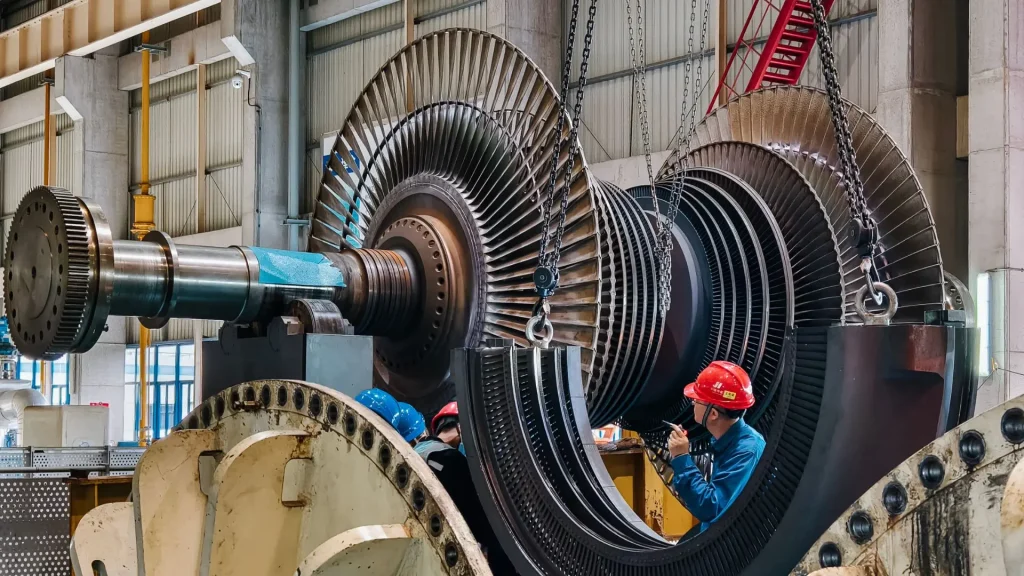
A monumental leap in industrial energy efficiency has just been announced, originating from China. The China National Nuclear Corporation (CNNC) has successfully connected the world’s first commercial supercritical carbon dioxide (sCO2) power generator to the grid. This groundbreaking system, deployed within a steel production plant in Guizhou province, promises to redefine how industries harness waste heat, paving the way for a more sustainable and ‘smart’ manufacturing future.
Unlike traditional steam-based systems, this innovative generator utilizes carbon dioxide in its supercritical state to transfer heat. This unique phase, where CO2 exhibits properties of both a gas and a liquid above a critical pressure and temperature, enables significantly higher energy conversion efficiencies. Reports indicate the two 15-megawatt units are at least 50% more efficient at converting waste heat into electricity than their conventional steam counterparts, which typically hover around 40% efficiency for high-temperature sources.
Supercharging Smart Manufacturing with Waste Heat Recovery
The immediate application of this technology in a steel plant’s sintering process is a game-changer for smart manufacturing. Steel production is notoriously energy-intensive, and the ability to reclaim high-temperature waste heat (over 1,292 degrees Fahrenheit / 700 degrees Celsius) and transform it into usable electricity dramatically improves the overall energy footprint of the facility. This directly contributes to operational cost reduction, reduced carbon emissions, and enhanced sustainability – core tenets of any modern smart factory initiative.
The compact nature of sCO2 power generators, attributed to the higher density of supercritical carbon dioxide compared to steam, also offers significant advantages. These smaller footprint systems can be integrated into existing industrial infrastructure more easily, facilitating retrofits and expansions aimed at maximizing energy recovery across various manufacturing sectors.
Beyond the Factory Floor: A Clean Energy Revolution
While the initial deployment is within industrial manufacturing, the potential applications of this technology are far-reaching. The 15 MW system, developed by China’s Nuclear Power Institute over a decade, is scalable and could eventually replace steam variants in diverse settings. Experts foresee its use in utility-scale power generation, nuclear energy (including mobile nuclear reactors), spacecraft, and even advanced solar thermal plants. This versatility underscores its potential to revolutionize clean energy systems globally.
A Global Race for Supercritical Efficiency
China’s achievement marks the first commercial grid-connected sCO2 generator, but the pursuit of this technology is a global endeavor. The United States, for instance, has its own Supercritical Transformational Electric Power (STEP) demo pilot plant in Texas, backed by partners like SwRI, GTI Energy, GE Vernova, and the US Department of Energy. This 10 MW system achieved significant milestones in 2024, demonstrating 4 megawatts of electricity generation at 932 degrees Fahrenheit (500 degrees Celsius) during its initial testing phase. The final phase aims for 10 MW at even higher temperatures, showcasing a shared international commitment to advancing sCO2 power generation.
The advent of commercial supercritical CO2 power generation signifies a pivotal moment for industrial sustainability and global energy efficiency. By turning industrial waste into valuable electricity, China is not just powering a steel plant; it’s powering the future of smart manufacturing and a cleaner, more efficient industrial world.

CTO Robotics
CTO Robotics is a global media and consulting company dedicated to robotics, automation, artificial intelligence, and emerging technologies. We create high-impact content that reaches engineers, decision-makers, and innovators worldwide. Through articles, videos, social media campaigns, and community-driven storytelling, we help companies showcase their technologies, strengthen their brand, and connect with the right audience. Much like Interesting Engineering or Wevolver, our mission is to bridge the gap between technology providers and industry professionals — turning innovation into visibility, and visibility into growth. 👉 Whether you are launching a new product, building your brand, or looking for global recognition, CTO Robotics is your media partner for exposure, credibility, and business opportunities.
All stories by: CTO Robotics









0 Comments